THE VETIVER GRASS SYSTEM:
POTENTIAL APPLICATIONS FOR SOIL AND WATER CONSERVATION
IN NORTHERN CALIFORNIA
(Invited paper presented at the STIFF GRASS TECHNOLOGY Seminar,
sponsored by the Yolo County Flood Control & Water Conservation District
and Family Water Alliance at Woodland on 9 May 2 000)
Dr Paul Truong
Principal Soil Conservationist
Department of Natural Resources, Brisbane, Australia.
ABSTRACT
The Vetiver System (VS) was first developed by the World Bank for soil and water conservation in India in the mid 1980s and it is based on the application of some extraordinary features of vetiver grass (Vetiveria zizanioides L). These include a massive and deep root system, tolerance to extreme climatic variations such as prolonged drought, flood, submergence, fire, frost and heat waves. It is also tolerant to a wide range of soil acidity, alkalinity, salinity, sodicity, agrochemicals and elevated levels of heavy metals in the soil.
VS is now being widely used for soil and water conservation in more than 100 countries including some states in southern U.S. Vetiver grass thrives under Mediterranean climate and in northern California, vetiver will grow for at least 6 months a year.
This paper presents the special characteristics of vetiver grass and its global uses for agricultural and environmental protection. Potential applications of the VS in northern California including soil and water conservation in sloping lands, flood erosion control, stream and levee bank stabilisation and offsite pollution control are discussed.
1. INTRODUCTION
The Vetiver System (VS), which is based on the application of vetiver grass (Vetiveria zizanioides L), was first developed by the World Bank for soil and water conservation in India in the mid 1980s. While this application still plays a vital role in agricultural land management, R&D conducted in the last 10 years has clearly demonstrated that, due to vetiver grass extraordinary characteristics, VS is now being used as a bioengineering technique for steep slope stabilisation and environmental protection (10,11, 24, 28).
2. SPECIAL CHARACTERISTICS OF VETIVER GRASS
2.1 Morphological Characteristics
2.2 Physiological Characteristics
2.3 Ecological Characteristics
Although vetiver is very tolerant to some extreme soil and climatic conditions mentioned above, as a C4 plant it is intolerant to shading. Shading will reduce its growth and in extreme cases, may even eliminate vetiver in the long term. Therefore vetiver grows best in the open and weed control may be needed during establishment phase. On erodible or unstable ground vetiver first reduces erosion, stabilises the erodible ground (particularly steep slopes), then improves its micro environment so other volunteered or sown plants can establish later. Because of these characteristics vetiver can be considered as a nurse plant on disturbed lands.
The summary of vetiver adaptability range is shown on Appendix 1.
2.4 Cold weather tolerance of vetiver grass
Although vetiver is a tropical grass, it can survive and thrive under extremely cold conditions. Under frosty weather its top growth is killed but its underground growing points survived. In Australia, vetiver growth was not affected by severe frost at —11oC (12 oF) and it survived for a short period at —22 oC (7.6 oF) in northern China (33). In Georgia (US), vetiver survived in soil temperature of -10 oC (14 oF) but not at —15 oC (5 oF) (13).
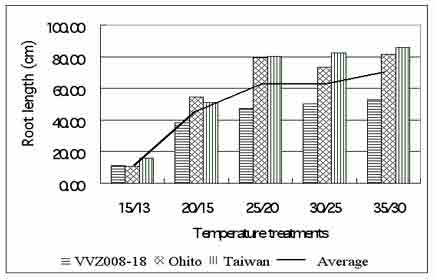
Recent research showed that 25oC (72oF) was optimal soil temperature for root growth, but vetiver roots continued to grow at 13oC (55oF). Although very little shoot growth occurred at the soil temperature range of 15 oC (day) and 13 oC (night) root growth continued at the rate of 126mm/day (5in.), indicating that vetiver grass was not dormant at this temperature (29) and extrapolation suggested that root dormancy occurred at about 5 oC (41oF ) (Fig.1)
Fig 1. The effect of soil temperature on the root growth of vetiver.
Genotypes: VVZ008-18, Ohito, and Taiwan, the later 2 are basically the same as Sunshine.
Temperature treatments: day 15 oC /night 13 oC
3. VETIVER GRASS GROWTH IN YOLO COUNTY
The average air and soil temperatures at Davis shown in Appendix 2 indicate that Yolo County has a relatively mild winter and warm summer. As vetiver roots continued to grow at soil temperature of 55 oF (27), it is expected that vetiver will start growing by late March when minimum soil temperature is around 56 oF and continue until early November, when soil moisture permitted.
Vetiver produced on average 200 tillers after two years and up to 6 feet tall, with best growth occurs at ambient temperature of about 70 oF. Vetiver grass survived —8oC (17 oF) for 10 consecutive days in the early 1990s. The plants were frost burnt to the ground but rebounded vigorously in spring
(J. Eagan pers. com.).
4. VETIVER GRASS ON THE U.S. MAINLAND.
Vetiver grass was introduced to the USA early in the 19th Century (13). Its roots were used primarily as an insect repellent and its tops as mulch for garden crops; it was also a popular ornamental plant. More importantly in more than 150 years since its introduction (perhaps via Haiti) it has shown no evidence of invasiveness, in fact it is so "tame" that vetiver was promoted for soil and water conservation in the Gulf states and planting material could be found at sites where it had persisted without spreading since pre-civil war times. Vetiver has been grown commercially in Texas on one farm for aromatic oil production, but operations ceased as production prove uneconomic (Grimshaw pers.com).
USDA first introduced vetiver to California before World War II for testing at Indio and Lockeford and later at Pomona in southern California. There it has proven to survive extreme drought, for years without fertilisers, irrigation or other maintenance, following establishment with irrigation in the first year. In the past two years landscapers in southern California have started using it successfully for stabilising slopes that are prone to mud slides (Grimshaw pers.com). Vetiver has been used successfully to stabilise and rehabilitate a badly eroded embankment at Pomona. In addition, California Black Walnut seedlings established themselves in pockets of rich organic matter created by the vetiver hedges. Four years after vetiver planting, watered only by natural rainfall, lush green vetiver and young trees covered the embankment. At other two sites at the Spirit Mountain, vetiver has also been very successful in erosion control and water absorption (17).
In the last 7 years the US Army Corps of Engineers have conducted extensive trials using vetiver for the rehabilitation of the army training grounds in several states (VA, IL, MS, NC, GA, KY, AR, TX, MO, LA, OK and KS). Results so far indicated the vetiver is non-invasive, non-aggressive and does not like competition from native grasses. Vetiver can survive on infertile and sandy soil where even native plants do not grow at all, providing an excellent sediment filter and effective against erosion, while serving as a nurse plant for subsequent native plant establishment. However vetiver is not cold tolerant above latitude 40o N (16). In Louisiana, Dr. Kittie Derstine (pers.com.) has used vetiver successfully for land stabilisation and erosion and sediment control on training ground at Ft Polk in the last 10 years.
5. GENETIC CHARACTERISTICS
There are two V. zizanioides genotypes being used for soil and water conservation, and land stabilisation purposes:
While the seeded genotype is only used in northern India, the southern and sterile genotype is used for essential oil production around the world, and the latter is the genotype that being used for soil and water conservation and land stabilisation purposes. Results of the Vetiver Identification Program, by DNA typing have shown that of the 60 samples submitted from 29 countries outside South Asia, 53 (88%) were a single clone of V.zizanioides. These 53 samples tested came from North and South America, Asia, Oceania and Africa and among these 53 cultivars are: Monto (Australia) and Sunshine (USA) (1). Recent analysis have confirmed this distinction and shown a clear and replicable separation between the seedy and non fertile types ( R. Adams pers.com.)
6. WEED POTENTIAL
It is imperative that any plants used for environmental protection will not become a weed. To comply with the very strict Australian rules on introduced plants, a sterile vetiver cultivar was selected (from a number of existing cultivars in Australia) and exhaustively and rigorously tested for eight years for its sterility under various growing conditions. The Queensland Department of Primary Industries has approved this cultivar for use in soil conservation and it was registered in Australia as Monto vetiver, which is identical to the Sunshine genotype used in the United States (1).
In Fiji where vetiver grass was introduced to the country for more than 100 years and it has been widely used for soil and water conservation purposes for more than 50 years, vetiver grass has not become a weed in the new environment (20).
In the US, although vetiver has been in Louisiana for more than 150 years, it has not become a weed. Today, vetiver can be found planted along the bank of many bayous and on old plantations where it has been essentially ignored since at least last century. There have been no reports of colonisation. Vetiver was also present in Florida for probably a century or more, it has never been reported as weed in cultivation (13).
As with all non fertile plants, vetiver can only be vegetatively propagated and planted. Planting materials are obtained by sub dividing the crown of a mature plant; they are supplied as slips or splits in various forms suitable for different applications.
Although vetiver grass is very resilient under the most adverse conditions it can be eliminated easily either by spraying with glyphosate herbicide (3) or uprooting and drying out by hand or farm machinery.
7. SOIL AND WATER CONSERVATION ON SLOPING LANDS IN YOLO COUNTY
As a living porous barrier vetiver hedge slows and spreads runoff water and traps sediment. As the flow is slowed down, its erosive power is reduced and at the same time allows more time for water to infiltrate to the soil, and the hedge traps any eroded materials (7). Therefore an effective hedge will reduce soil erosion, conserve soil moisture and trap sediment on site. When appropriately laid out these hedges can also act as very effective diversion structures spreading and diverting runoff water to stable areas or proper drains for safe disposal.
This is in sharp contrast with the contour terrace/waterway system which runoff water is collected by the terraces and diverted as quickly as possible from the field to reduce its erosive potential. All this runoff water is collected and concentrated in the waterways where most erosion occurs in agricultural lands, particularly on sloping lands and this water is lost from the field. With the VS not only this water is conserved but also no land is wasted on the waterways.
Table 2. Effects of the vetiver System on soil loss and runoff in agricultural lands
(Data extracted from papers presented at the International Vetiver Conference,
Thailand, January 2 000) (15)
Countries |
Soil loss (t/ha) |
Runoff (% of rainfall) |
||||
Control |
Conventional |
VS |
Control | Conventional | VS |
|
Thailand |
3.9 |
7.3 |
2.5 |
1.2 |
1.4 |
0.8 |
Venezuela |
95.0 |
88.7 |
20.2 |
64.1 |
50.0 |
21.9 |
Venezuela (15%)* |
16.8 |
12.0 |
1.1 |
88 |
76 |
72 |
Venezuela (26%)* |
35.5 |
16.1 |
4.9 |
|||
Vietnam |
27.1 |
5.7 |
0.8 |
|||
Bangladesh |
42 |
6-11 |
||||
India |
25 |
2 |
||||
14.4 |
3.9 |
23.3 |
15.5 |
|||
* Land slope
Research conducted on soil moisture competition between crops and vetiver hedges showed that no competition occurred under irrigation between vetiver and both shallow-rooted crop as bean and deep-rooted crop as sorghum. In rain fed farming, no competition occurred under average rainfall conditions, but vetiver hedges reduced sorghum establishment and yield in drought years. On vertisol soil, distance up to 1.5m (5 feet) from the hedge was affected (9).
In low rainfall regions of Asia and Africa, vetiver hedges when planted either in long rows or semi-circles around fruit trees have improved yield. In Thailand lychee yield improves by up to 20% by this water harvesting technique. Evaporation loss is also reduced when the trimmed tops are used to mulch fruit trees. In high runoff area, when planted on a gradient, vetiver hedges are also very effective in collecting and diverting water to storage dams.
When planted in row, vetiver plants will form a thick hedge and with their stiff stems these hedges can stand up to water flow at least 0.6m deep, forming a living barrier which slows and spreads runoff water. Hydraulic characteristics of vetiver hedges under deep flow are described in Fig.2 (8).
Figure 2. Hydraulic model of flooding through vetiver hedges.

Where:
q = discharge per unit width y = depth of flow y1 = depth upstream
So = land slope Sf = energy slope NF = the Froude number
3.2.2 Flood erosion control
Based on the above model, VS has been used very successfully for flood erosion control on the floodplains of Queensland, Australia, where strip-cropping practice is generally used for this purpose. This practice relies on the stubble of the previous crop for erosion control of fallow land and young crops. On an experimental site of over 100 ha, vetiver hedges that were established at 90m intervals to provide a permanent protection against flood water. Results over the last several years, (including several major floods) have shown that VS has been very successful in reducing flow velocity and limiting soil movement, with very little erosion in fallow strips and the young crop was fully protected (8,9).
The incorporation of vetiver hedges as an alternative to strip cropping on floodplains has resulted in more flexibility, more easily managed land and more effective spreading of flood flows in dry years particularly with low stubble producing crops such as cotton and sunflower. An added major benefit is that the area cropped at any one time could be increased by up to 30% (9).
9. STREAM, IRRIGATION CHANNEL AND LEVEE BANKS STABILISATION
Vetiver is highly tolerant to water logging condition; this in combination with its extensive root system vetiver provides a highly effective means of stream and levee bank, and irrigation channel stabilisation in Australia and South Africa (26).
Planting on the outside of a dam wall, vetiver stabilises the steep batter; planting inside the wall protects it from wave erosion.
10. OFFSITE POLLUTION CONTROL
10.1 De-eutrophication of polluted water
Algal growth in rivers and dams are major concerns around the world, as soluble N and particularly P are usually considered to be key elements for water eutrophication, which normally leads to blue green algal growth in inland waterways and lakes. The removal of these elements by vegetation is a most cost effective and environmental friendly method of controlling algal growth.
Chinese researchers have shown that:
10.2 Trapping and Decontaminating Agrochemicals and Nutrients
Sediment and runoff analyses associated with the monitoring the quality of water in tropical Queensland have indicated that, in general, greater than 95% of the nitrogen and phosphorus lost in the runoff are associated with the particulate fraction. Therefore the key in controlling off-site pollution by nutrients and agrochemicals is to control sediment movement. If the sediment could be effectively trapped at source, the degree of downstream pollution would be greatly reduced. Vetiver hedges have been shown to be a very effective and low cost means of retention and decontamination of particle-bound agro-chemicals, especially pesticides and nutrients in runoff water from agricultural lands.
11. ARTIFICIAL WETLANDS
The use of wetlands for the removal of pollutants involves a complex variety of biological processes, involving microbiological transformations and physio-chemical processes such as adsorption, precipitation or sedimentation. The ability of vetiver to tolerate flooded soil conditions and to absorb and decontaminate high levels of agrochemicals and nutrients makes it very suitable for use in ephemeral or permanent wetlands. Its dense stands of stiff, erect stems can reduce flow velocity, increase detention time and enhance deposition of sediment and sediment-bound contaminants. Furthermore, vetiver dense and finely structured root system can improve bed stability and nutrient uptake, and provide an environment that stimulates microbiological processes in the rhizosphere.
Fig 3: Herbicide concentration in soil deposited upstream
and downstream of vetiver filter strips
11.1 Tolerance to Agrochemicals in Wetlands
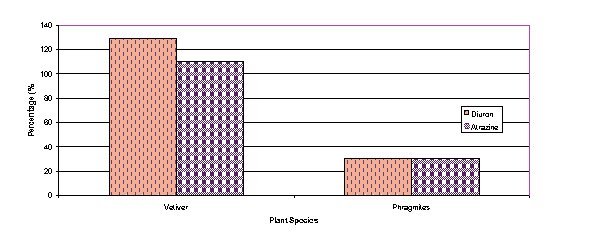
Results of a study set up to explore the potential for expanding the application of VS for use (as a vegetative buffer or in shallow wetlands) in the treatment of runoff and other waste waters, particularly agricultural runoff, confirmed the ability of vetiver to establish and grow well in a shallow wetland environment. Importantly, the results also clearly demonstrated that growth and performance of vetiver were not affected by exposure to the herbicides, atrazine and diuron, at concentrations likely to be found in agricultural runoff or water bodies downstream. Indeed, vetiver was shown to be unaffected by either herbicide at concentrations as high as 2,000 m g L-1; levels which are likely to be encountered in the environment only in situations of accidental spillage, or direct application to waterways (Fig.4,5), (6).
Results of a comparative study conducted to determine the ability of iris (Iris pseudacorus), common club-rush (Schoenoplectus lacustris) and vetiver to enhance the removal or degradation of atrazine in a simulated wetland environment, show that iris and vetiver were far more effective than club-rush in lowering the atrazine levels in the soil. This was attributed to firstly the ability of both plants to absorb large quantity of atrazine and secondly to the enhanced activity of micro-organism in the rhizosphere of these two plants. While iris translocated most of its absorbed atrazine to its tops, vetiver retained it in its extensive root system (31).
However, although iris outperformed vetiver in the removal of atrazine from the soil under wetland environment, iris showed sign of stress throughout the experiment. On the other hand vetiver growth was not affected, indicating that in the long term vetiver may be a better plant for this application.
on the whole plant dry weight of vetiver at harvest.
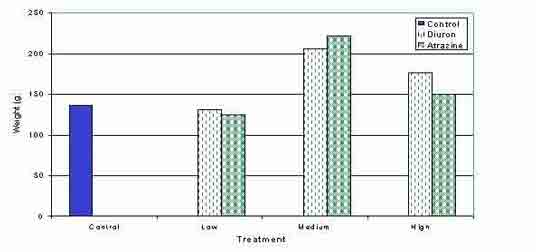
Figure 6: Whole plant biomass (as a percentage of controls) of vetiver
and phragmites at the high rates of herbicide application.
12. WEED AND FIRE BARRIER AND WINDBREAK
When fully developed vetiver forms a very thick barrier, which can stop stoloniferous or creeping grass such as Bermuda grass spreading. The thick growth of the vetiver hedges also provides excellent windbreak for young tree and vegetable crops.
Even in a very dry state vetiver top does not burn readily and remains green during summer so vetiver is being used in South Africa as a fire barrier protecting forest plantation from creeping grass fire.
13. APPROPRIATE DESIGN AND MANAGEMENT
The success of all the applications mentioned above depends on the proper design and application of the VS. To ensure success appropriate management practices have to be developed for each region and each application. Practices that promote good establishment and growth during summer months are most important during establishment phase and those encouraging early regrowth in spring need to be developed for each region.
14. CONCLUSION
As vetiver has been successfully established and thrived in northern California and global experience proves that VS is a very effective, low cost and simple-to-manage soil and water conservation practice, the Vetiver System will provide a great potential to this region for agricultural productivity improvement and environmental protection.
9. REFERENCES
Appendix 1
Adaptability Range of Vetiver in Australia and other Countries
| Adverse Soil Conditions | Australia | Other Countries |
| Acidity | pH 3.0 | pH 4.2 (with high level soluble aluminium) |
| Aluminium level (Al Sat. %) | Between 68% - 87% | 80%-87% |
| Manganese level | > 578 mgkg-1 | |
| Alkalinity (highly sodic) | pH 9.5 | pH 10.5 |
| Salinity (50% yield reduction) | 17.5 mScm-1 | |
| Salinity (survived) | 47.5 mScm-1 | |
| Sodicity | 48% (exchange Na) | |
| Magnesicity | 2 400 mgkg-1 (Mg) | |
| Heavy Metals | ||
| Arsenic | 100 - 250 mgkg-1 | |
| Cadmium | 20 mgkg-1 | 22 mgkg-1 |
| Copper | 35 - 50 mgkg-1 | 174 mgkg-1 |
| Chromium | 200 - 600 mgkg-1 | |
| Nickel | 50 - 100 mgkg-1 | |
| Mercury | > 6 mgkg-1 | |
| Lead | > 1 500 mgkg-1 | 3 123 mgkg-1 |
| Selenium | > 74 mgkg-1 | |
| Zinc | >750 mgkg-1 | 3 418 mgkg-1 |
| Latitude | 150S - 370S | 410N - 380S |
| Altitude | 2 800m | |
| Climate | ||
| Annual Rainfall (mm) | 450 - 4 000 | 250 - 5 000 |
| Frost
(ground temp.) (soil temperature) |
-110C (12 oF) | -220C
(7.6 oF) -100C (14 oF) |
| Heat wave | 450C (113oF) | 600C (140oF) |
| Drought (without effective rain) | 15 months | |
| Fertiliser | ||
| Vetiver can be established on very infertile soil | N
and P (300 kg/ha DAP) |
N and P, farm manure |
| Palatability | Dairy cows, cattle, horse, rabbits, sheep, kangaroo | Cows, cattle, goats, sheep, pigs, carp |
| Nutritional Value | N
= 1.1 % P = 0.17% K = 2.2% |
Crude
protein 3.3% Crude fat 0.4% Crude fibre 7.1% |
Appendix 2
Air and Soil Temperature at Davis, Yolo County.
| Month | Air (OF) |
Soil (OF) |
|||
Max |
Min |
Max |
Min |
Average |
|
| Jan | 57 |
40 |
49 |
46 |
46 |
| Feb | 58 |
43 |
55 |
48 |
51.5 |
| Mar | 67 |
43 |
62 |
52 |
57 |
| April | 71 |
44 |
72 |
89 |
65.5 |
| May | 79 |
48 |
83 |
69 |
76 |
| June | 85 |
52 |
90 |
77 |
83.5 |
| July | 87 |
54 |
96 |
81 |
88.5 |
| August | 88 |
55 |
95 |
79 |
87 |
| September | 89 |
54 |
87 |
73 |
80 |
| October | 81 |
49 |
75 |
65 |
70 |
| November | 65 |
44 |
58 |
52 |
55 |
| December | 61 |
34 |
49 |
44 |
46.5 |